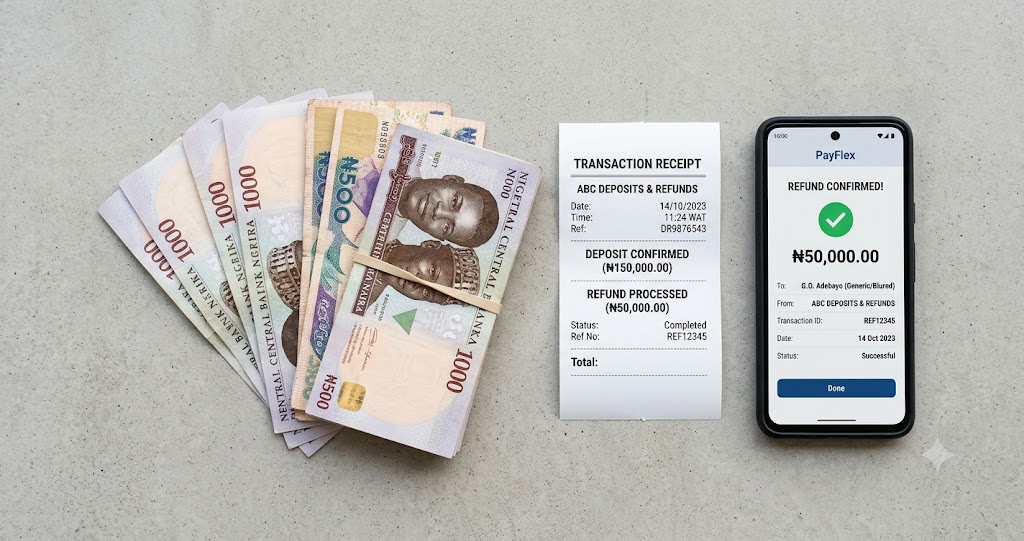
What Is a Caution Fee on a Shortlet? Meaning and How to Get It Back
A caution fee on a shortlet is a refundable security deposit that a host or booking platform collects before check-in to cover potential damage to the apartment — it is not rent, and if you leave the unit in the condition you found it, you should get it back in full. Nigerian shortlet caution fees typically run from ₦10,000 to ₦50,000 or more depending on the property, and the biggest source of guest frustration isn't the fee itself but the refund process afterward: hosts who delay, deduct without explanation, or simply go quiet once checkout is done.
If you've ever paid a caution fee and wondered whether you'd actually see that money again, you're asking the right question. Here's what the fee actually covers, how it differs from a security deposit or rent, and the steps that get you your money back without a fight.
What a Caution Fee Actually Means
A caution fee is a refundable sum collected as financial protection against potential damages or losses during a stay, separate from the nightly rate you pay for the apartment itself. Property owners and shortlet hosts across Nigeria use the term interchangeably with "security deposit," though the mechanics are simple: you pay it alongside your booking, the host holds it during your stay, and it's returned to you afterward minus the cost of any verified damage.
The fee is not a fee in the sense of a service charge — it's a deposit. That distinction matters if a host tries to treat it as non-refundable, which under Nigerian tenancy norms it generally isn't, provided you haven't damaged the property.
How Caution Fees Work on Verified Shortlet Platforms
On platforms that collect and hold the caution fee directly (rather than having you send it straight to a host's personal account), the deposit is collected at booking and withheld by the platform for the duration of the stay — it is only paid out to the host if damage occurs, and otherwise refunded to the guest within a set window after checkout, often around 24 hours. This is the safest structure for a guest, because the money sits with a neutral third party rather than a stranger you've never met in person.
The riskier version — increasingly common in informal listings on Instagram or WhatsApp — has the guest wiring the caution fee directly to the host or an "agent," with no receipt, no contract, and no recourse if the apartment turns out not to exist. One widely reported case involved a diaspora family defrauded of ₦1.3 million by a fake agent who took payment before disappearing.
Caution Fee vs. Security Deposit vs. Rent
These three terms get used loosely, but they mean different things:
Rent — what you pay for the right to occupy the apartment for the booked nights. Non-refundable once the stay happens.
Caution fee / security deposit — a separate, refundable sum held against damage. Not tied to occupancy.
Cleaning fee (where charged) — a fixed, non-refundable charge covering turnover cleaning, distinct from the caution fee.
If a host lumps all three into one non-refundable "fee," that's a red flag worth questioning before you pay.
When You're Entitled to a Refund
The caution fee is intended to be refundable, and if any damage occurs during your stay, the cost of repairs is deducted from the fee when your booking ends — but if no damage is done, the fee is meant to come back to you in full. Guests are generally entitled to a refund of the caution fee they paid, and delays or resistance from a host don't change that entitlement, even if some property owners try to push back on returning it.
In practice, refund timelines vary widely between informal listings and verified platforms. A platform that processes the refund automatically after a documented checkout inspection is far more reliable than one where you're waiting on a host to "get around to it."
How to Get Your Caution Fee Back
A few habits protect you regardless of which platform or host you're dealing with:
Document the apartment at check-in. Photos and a short video of every room, appliance, and existing damage, timestamped, before you unpack.
Get the fee terms in writing before paying. Ask exactly how much is refundable, the refund window, and who processes it.
Do a walkthrough at checkout with the host or their representative where possible, so any dispute about condition happens on the spot rather than after you've left the country or city.
Keep every payment receipt and message thread. If a refund is delayed, this is your evidence.
Follow up in writing, not just by phone, so there's a paper trail if you need to escalate.
If a host refuses to refund without a documented reason, you're within your rights to push back — but the stronger position is avoiding hosts who don't offer a transparent, documented process in the first place.
Avoiding Caution Fee Scams Altogether
The safest way to never have a caution fee dispute is to never send one to an unverified individual. Before paying any deposit: verify the host actually controls the property (via a call or video walkthrough), avoid listings that pressure you to pay in full before any inspection, and favor bookings made through a platform with verified listings, so the deposit is held and refunded by the platform rather than an anonymous host account. Ghecs holds caution fees on verified shortlet listings across Lagos, Abuja, and Port Harcourt and processes refunds through the platform rather than leaving it to an individual host's discretion.
Frequently Asked Questions
Is a caution fee the same as a security deposit?
Yes — in Nigerian shortlet and rental listings, "caution fee" and "security deposit" are used interchangeably to describe the same refundable sum held against damage during your stay.
How much is a typical caution fee for a shortlet in Nigeria?
It varies by property size and location, but caution fees on shortlet apartments commonly range from around ₦10,000 for a modest one-bedroom to ₦50,000 or more for larger or higher-end units.
How long does it take to get a caution fee refunded?
On platforms that hold the deposit directly, refunds are often processed within about 24 hours of checkout once no damage is confirmed. With informal, host-managed deposits, timelines are far less predictable and depend on the individual host.
Can a host keep my caution fee without explanation?
No. The fee is refundable unless there is documented damage; a host withholding it without a clear, itemized reason is not following standard practice, and you're entitled to ask for justification or a full refund.
What should I do if a host won't refund my caution fee?
Request a written explanation and any evidence of damage, escalate through the booking platform if one was used, and keep all payment and message records in case you need to dispute the charge with your bank or report the host.
Does the caution fee cover cleaning costs?
Not usually. Cleaning is typically covered by a separate cleaning fee where one applies; the caution fee is specifically meant for damage beyond normal wear and tear.
Book With Confidence
Every shortlet listed on Ghecs is verified before it goes live, with transparent pricing and a caution fee policy you can see before you book — no guessing, no wiring money to a stranger's account. Browse verified shortlet apartments on Ghecs and book knowing exactly what you're paying for and when you'll get it back.
Start Listing on Ghecs Today
Join thousands of property owners who trust Ghecs for their bookings.